



 KOR
KOR
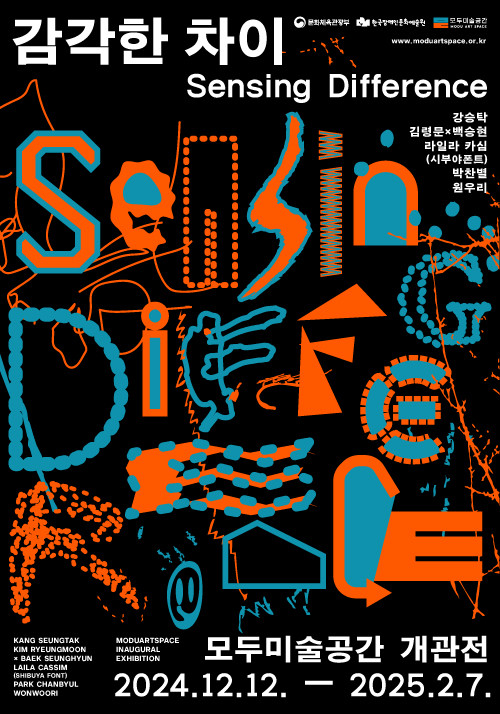
Sensing Difference
-
Date
2024-12-12 ~ 2025-02-07
-
Venue
Modu Art Space
-
Artists
KANG Seungtak, KIM Ryeungmoon x BAEK Seunghyun, Laila Cassim, PARK Chanbyul, WONWOORI
-
Audience
All ages
-
Program Type
Curated Exhibition
-
Tuition
Free
-
Time
10:00 ~ 18:00
-
Inquiries
+82 (0)2-760-9797
Preface
This is the inaugural exhibition of MODU ART SPACE, a newly established venue dedicated to visual arts by the Korea Disability Arts & Culture Center.
I am delighted to present the inaugural exhibition in this space, which was created to showcase disability arts and the artworks of disabled artists, as well as to foster the discovery of emerging talents in the field.
This exhibition features six artists: four with varying disabilities and two able-bodied artists. Over the course of two years, composer WONWOORI directed the creation of a video artwork inspired by the "breath composition" of a deaf dancer. In addition, the artist duo couple KIM Ryeungmoon × BAEK Seunghyun collaborated to produce a participatory installation artwork. Both pieces delve into the theme of Sensing Difference , where one sense transforms, offering new avenues of expression and perspectives.
Another notable aspect of this exhibition is its focus on the relationship between disabled artists and artistic communities. This exhibition introduces PARK Chanbyul, who transmutes the challenges of visual impairment into her own distinctive artistic identity, as well as KANG Seungtak, who was able to reorient his life path through the art organization NUGUNA corp. Additionally, the exhibition features the Shibuya Font project by design director Laila CASSIM, an international case of community collaboration that successfully bridges disabled artists and the local community in the heart of Tokyo's Shibuya district.
The exhibition Sensing Difference highlights each artist's unique creative world rather than focusing solely on their disabilities. Although disabilities may come with physical limitations, they do not represent an absence. Instead, they enable new forms of bodily experience, paving the way for an empowering and self-driven process of creating unique distinctions. Their artworks convey a compelling message, reimagining disability as a source of creative potential.
Another key theme of this exhibition is the emergence of disabled artists within Korean society. Amid various efforts in the art world to implement barrier- free and inclusive exhibitions, artists with disabilities are being discovered and
supported through diverse pathways.
To offer a closer look at these processes and outcomes, a space was created to introduce emerging artists in collaboration with art-related communities. I hope this space inspires pathways to sustain their creative endeavors and encourages the emergence of a new generation of disabled artists in the future.
Art does not bear the weight of disability. Through this exhibition, it is my hope that you will have the opportunity to
experience the creative distinctions of these artists, whose talents have long been overshadowed by the heavy label of disability in our society, as well as immerse yourself in the artistic worlds these artists have embodied through their
unique sensibilities.
OUM Jeongsoon | Art Director
What Difference
This exhibition, Sensing Difference , is composed of two distinct spaces, each defined by a different color.
The first Exhibition Hall, with its minimalist tone, has been curated to invite visitors to appreciate artworks that reflect the perspectives on sensation envisioned by artists who have steadily established their presence in the Korean art world. Stepping into the second Exhibition Hall, set against a backdrop of soft and muted pink, visitors encounter a space designed in a form where emerging artists based on communities that actively support the artistic endeavors of individuals with disabilities, express the act of sensing objects.
To create a sense of stability and comfort, the space incorporates gentle curves, an uncommon feature in traditional exhibition halls. Furthermore, the deliberate use of contrasting colors to distinguish the exhibition spaces reflects the unique identity of the newly inaugurated MODU ART SPACE, which was designed from the outset to embody a uniqueness that stands apart from conventional art venues. This distinction stems from the premise of disability arts, a condition that is unlikely to exist and perhaps should not exist in conventional exhibition spaces such as museums or galleries. If an exhibition in a conventional space were to operate on such a premise, it might inadvertently give rise to unintended discrimination between those with and without disabilities from the very moment of its inception.
Perhaps for this reason, I found the term “disability arts” vaguely uncomfortable from the very beginning of planning this exhibition. The mere fact that someone like me could attempt to curate an exhibition on disability arts might itself be a bold risk. Yet, I could not help but hold the contradictory hope that this reckless endeavor might, in some way, bridge the differences in thought that could arise between disability and able-bodied arts, and narrow the gap created by real-world discrimination that such differences might inadvertently foster.
I once watched a TV program about Gestalt psychological counseling. Gestalt, a German word meaning “the whole form”, refers to a therapeutic approach that helps clients independently recognize contradictions among their inner sensations, emotions, and expressions. This process enables them to restore their overall form of self and gain awareness of their existence. It does not seek to deny or ignore differences but rather embraces them as variations, recognizing them as essential components of a greater whole.
In this context, the term “disability arts” functions not only as a marker distinguishing disability from being able-bodied but also as a crucial puzzle piece in the larger picture of who we are; it drives efforts to reduce discrimination but risks being discarded if it is dismissed as being too uncomfortable. Like an absence that affirms existence or a signifier conveying what is signified, I found myself hoping that, perhaps because this is the realm of art, such contradictions could transmute into energy that wields influence and adds profound value.
This is only the beginning, and there is still a long way to go. Yet, while we focus on the six artists who have stepped into this newly established space, we can see that the answer becomes clear. Setting aside perceived differences and embracing their act of sensing difference is the greatest support we can offer them - in this place and at this
moment.
KIM Jeongmin | Exhibition Curator